On September 16, 2026, IEC held a graduate program workshop in Xingwen Building. Professor Xu Bin of the Institute and graduate students majoring in World History participated in the event. The workshop focused on modern British finance and investment. PhD candidate Liu Tao also presented his recent research progress.
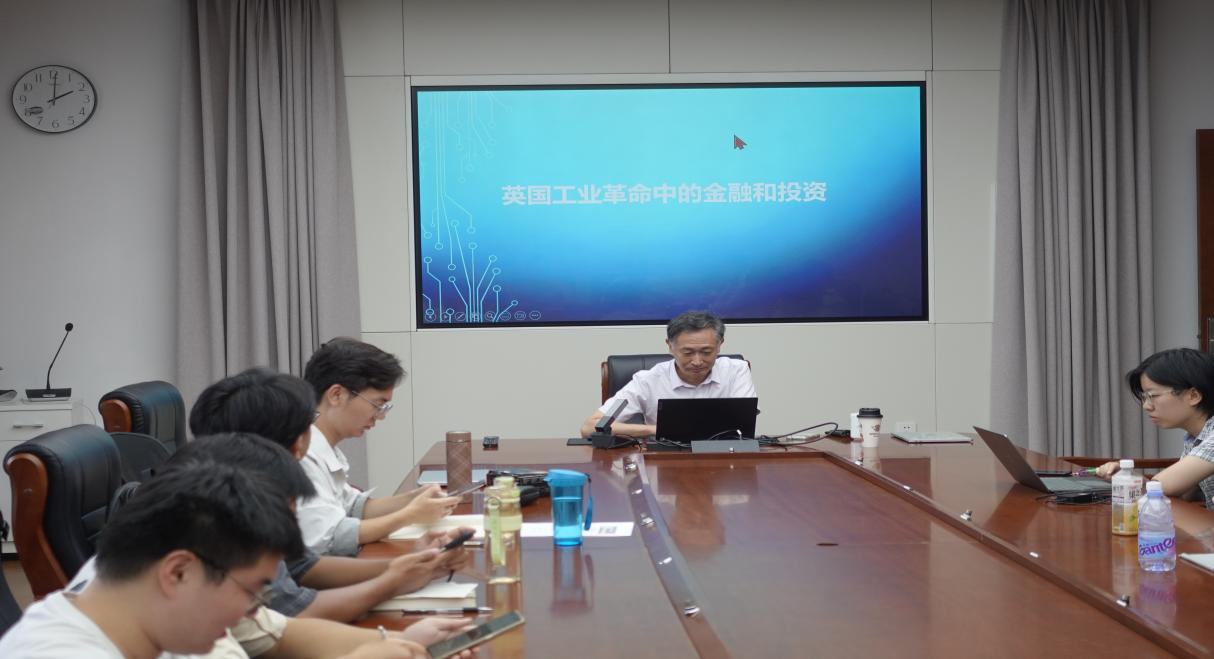
Professor Xu Bin addressed key aspects of early modern British financial innovation. He noted that the seventeenth century witnessed significant financial innovation in England, with money gradually transitioning from commodity money to credit money. After the Glorious Revolution, England constructed a public credit system underpinned by tax guarantees. Capital, he argued, is not merely a stock of wealth but social surplus directed toward reproduction; at the time, England possessed ample social capital in aggregate, yet capital circulation in the industrial sector faced obstructions. Legal protections and the payment environment both affected capital allocation—a core issue worthy of investigation in British financial history.
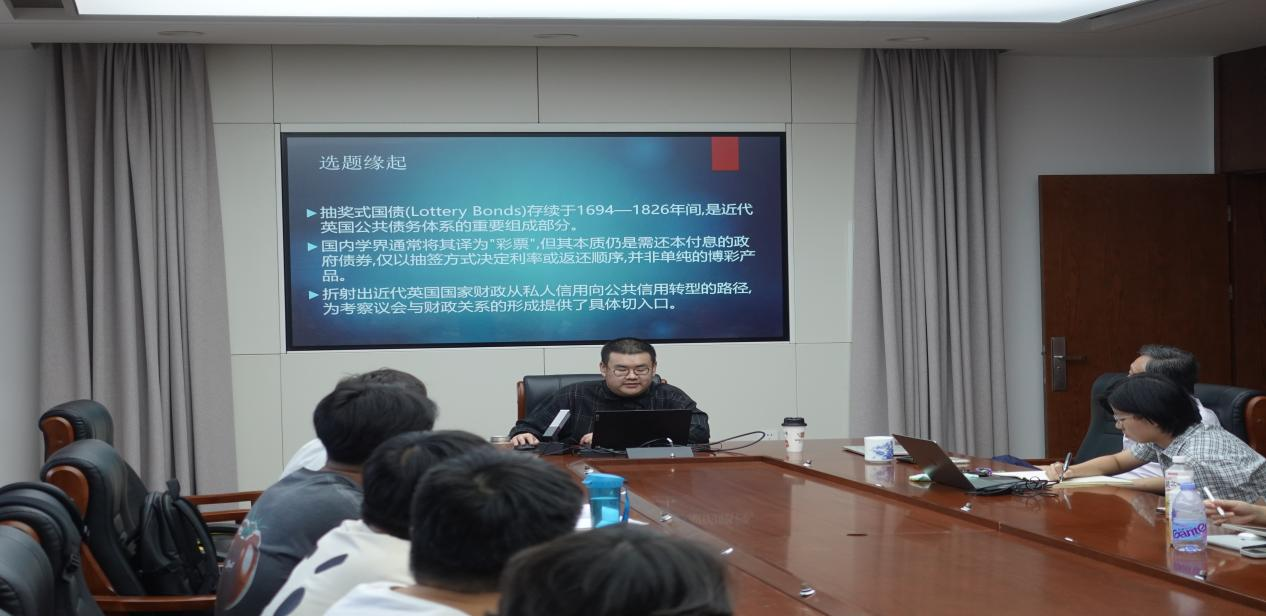
PhD candidate Liu Tao then delivered a focused presentation on lottery bonds from 1694 to 1826. He emphasized that lottery bonds were not ordinary gambling lotteries but government bonds requiring repayment of principal and interest, serving as an important window into England's transition from private credit to public credit. The report traced the development of these bonds: before the Glorious Revolution, lotteries were primarily private fundraising mechanisms; after Parliament took over, England officially issued lottery bonds in 1694. Aristocrats, gentry, merchants, bankers, and even women were significant investor groups. The funds raised were used both for war expenses and for public works such as Westminster Bridge and the British Museum. Due to rising operational costs and declining fiscal returns, Parliament terminated this bond program in 1823.
During the interactive session, faculty and students engaged in lively exchange and discussion around questions such as why private banks were initially able to issue paper money. Professor Xu Bin provided a systematic and comprehensive answer, encouraging students to ground their work in primary archival sources and to understand grand historical questions through small entry points, thereby consolidating their foundation in historical research. The seminar provided a sound platform for academic exchange, deepened faculty and students' understanding of the modern British public credit system, and promoted the normalization of faculty-student academic interaction at the Institute.