On the morning of September 23, the 121st session of the "Qiushi Forum" at Tianjin Normal University was held in the University's Convention Center. The forum featured Professor Han Dongyu, a First-Class Professor of Humanities and Social Sciences of China, Convener of the History Discipline Appraisal Group (World History) of the 8th Academic Degrees Committee of the State Council, and former Vice President of Northeast Normal University, who delivered a lecture entitled "On Japan's 'Dual' Political Structure." The lecture was chaired by Professor Qin Long, Member of the Standing Committee of the CPC Committee and Vice President of TNU. In attendance were Professor Hou Jianxin, Distinguished Professor of the University and Director of the Institute of European Civilization, along with faculty members and graduate students from relevant schools, totaling more than 200 participants.
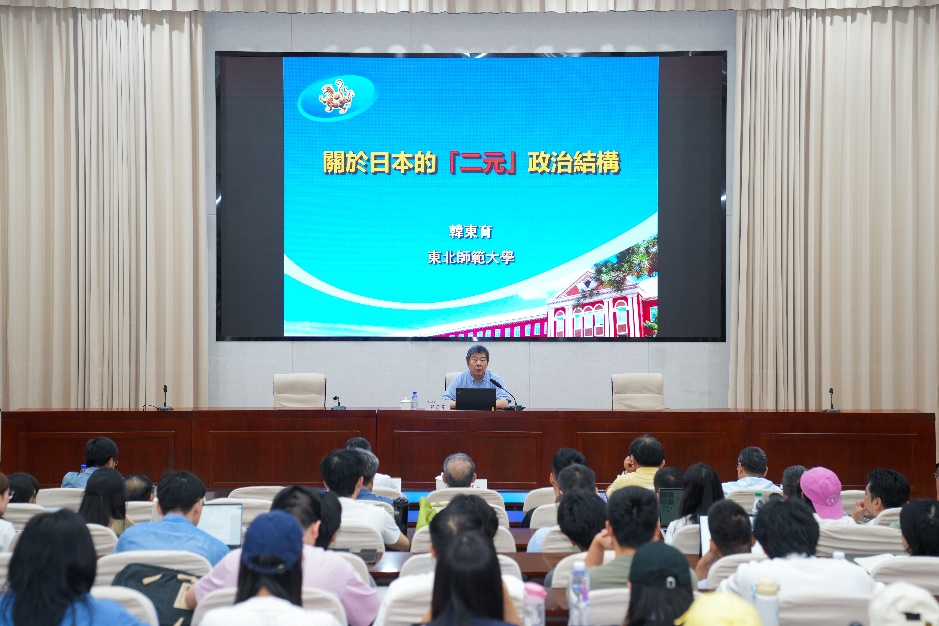
Taking Japan's distinctive "dual" power structure as its central thread, Professor Han systematically traced the evolution of power configurations throughout Japanese history and provided an in-depth interpretation of the dual political structure that has persisted since ancient times. He pointed out that this pattern of coexisting powers endured for several centuries, continuing from antiquity through the shogunate era before finally coming to an end in the Meiji period. During the Meiji era, under the dual pressures of Western national oppression and the aspiration for national independence, Japan ultimately brought the dual political structure to a close and established a highly centralized model of power.
Following the lecture, Professor Han engaged in a lively exchange with faculty and students, patiently and thoroughly addressing their questions and sharing original insights from his own research perspectives. The discussion was enthusiastic and the atmosphere of scholarly exchange vibrant.
With its broad comparative perspective and rigorous historical framework, this lecture provided faculty and students with an illuminating analytical lens for understanding Japan's history and contemporary politics. It is of great significance for advancing the development of the World History discipline at the University, broadening the scope of East Asian historical studies, and fostering the training of high-caliber talent in historical research.