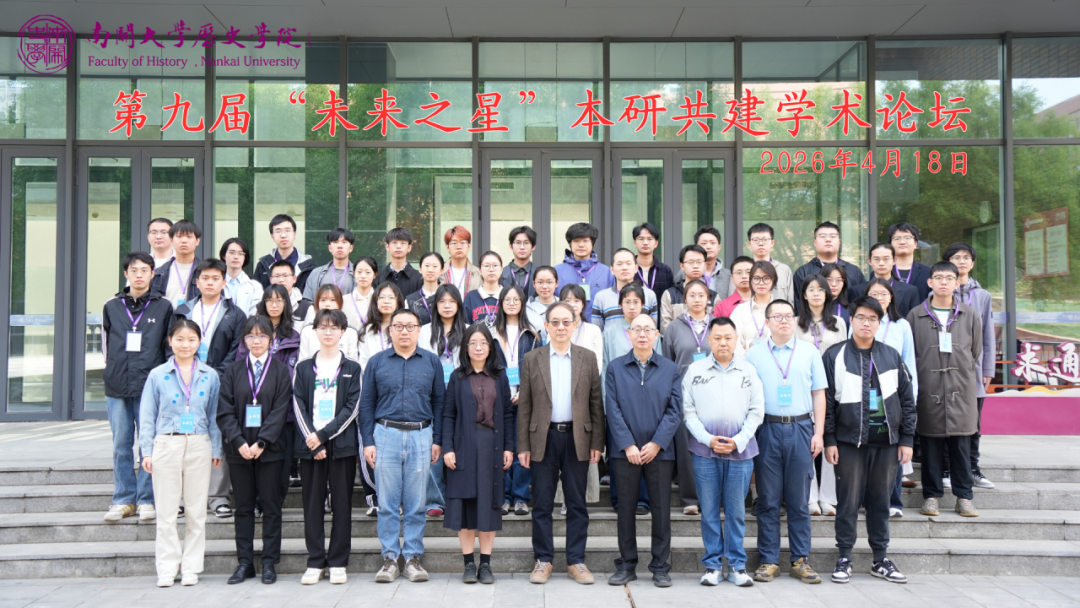
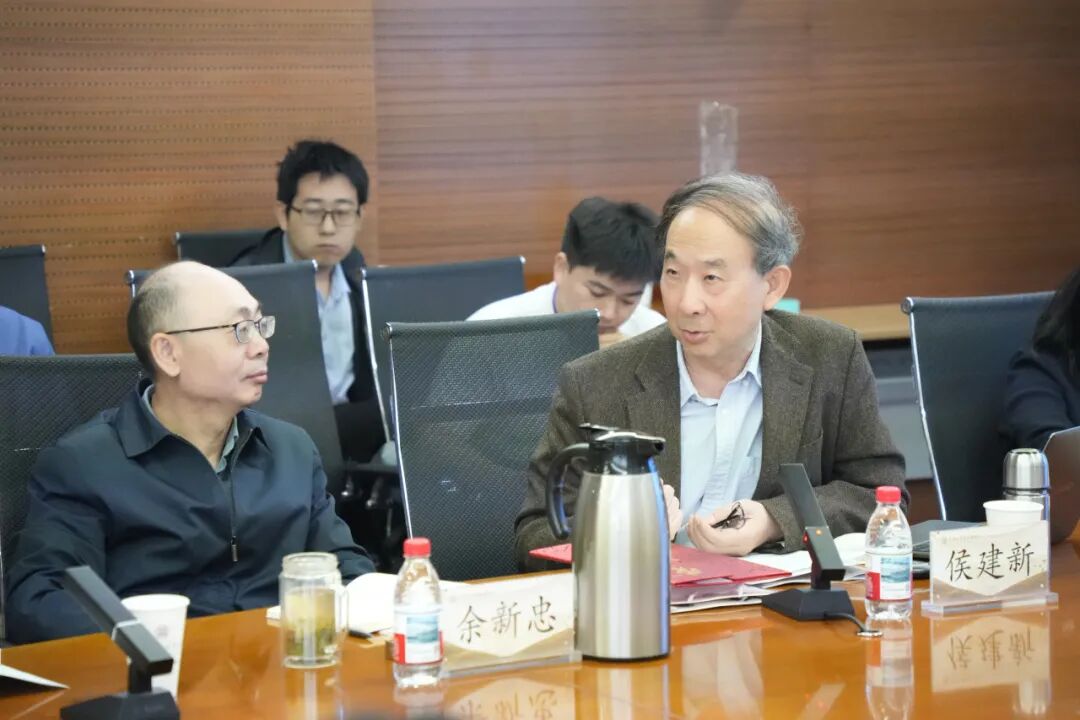
The first keynote lecture of the 9th "Future Star" Undergraduate-Postgraduate Co-construction Academic Forum, hosted by the School of History, Nankai University, was held on April 18th, 2026. Delivered by Professor Hou Jianxin, Senior Professor of Tianjin Normal University and Director of the Institute of European Civilization, the lecture was entitled Ambiguous Land Property Rights and Divergent Paths of Chinese and Western Civilizations, and presided over by Professor Yu Xinzhong, Dean of the School of History, Nankai University.
At the beginning of the lecture, Professor Hou expressed high expectations for the event. He indicated that in an era flourishing with artificial intelligence, humanities, as the fundamental theoretical cornerstone underpinning the long-term development of a nation and its people, have become increasingly irreplaceable. Professor Hou pointed out that despite commonalities between Chinese and Western civilizations, their social structures differ far more markedly. As the most valuable real estate with the most intricate legal relations in traditional societies, land serves as an optimal entry point for understanding such divergences. He stressed that discrepancies in contextual connotations and translational deviations have given rise to numerous misinterpretations in the research on Chinese and Western land property rights. Therefore, sorting out the historical evolution of land and property rights is essential to a clearer understanding of the divergent developmental paths of Chinese and Western civilizations.
Professor Hou first distinguished between modern and pre-modern property rights. Citing the viewpoints of William Holdsworth and Karl Marx, he contended that the core of modern property rights lies in the absoluteness of ownership. Stripped of all traditional attachments and additional constraints, modern ownership assumes a purely economic form as absolute private property. By contrast, property rights in pre-modern societies were generally ambiguous and compound in nature.
Against this theoretical backdrop, he analyzed the translational dilemma of the term "Feudalism". He noted that Yan Fu’s initial transliteration of Feudalism as "Fu te zhi" was more academically precise. Nevertheless, influenced by social evolutionary theory and the trend of ideological labelling, the term was eventually rendered as "Fengjian", leading to the generalization and conceptual confusion of its connotation. He further compared the essential nature of feudalism in China and the West: the enfeoff system of the Western Zhou Dynasty was rooted in consanguineous patriarchal clans, centered on "establishing states through kinship affinity"; European feudalism, by contrast, was inherently built upon contractual and personal dependency relations, with the lord-vassal bond at its core. Following the medieval maxim “The vassal of my vassal is not my vassal”, European social governance stood fundamentally distinct from the registered household system under Chinese imperial power.
In analyzing Sino-Western land property relations in depth, Professor Hou observed that China adopted a registered household system, under which peasants were essentially tenants subject to imperial power and obligated to pay taxes and perform corvée labour. The institutional principle that “All land under heaven belongs to the monarch” was firmly established. Meanwhile, peasants possessed the rights to land transaction, transfer and inheritance. Under European feudalism, land ownership was likewise compound and overlapping; a single plot of land could entail legal claims from as many as nine stakeholders, blurring the boundary of rights between lords and peasants—a notable common ground shared by China and medieval Europe.
The fundamental divergence lay in the fact that European peasants strove to strive for legal rights and encroach upon the ambiguous space of power through judicial means. Professor Hou particularly highlighted the pivotal role of medieval manorial courts and the jury system. By invoking customary law and contractual spirit, peasants engaged in institutional bargaining with lords in judicial proceedings, keeping land rents stable and even declining over time, which enabled them to accumulate private wealth. In comparison, although land transaction and inheritance prevailed in traditional China, imperial control over land and population remained unshaken. Lacking institutional rights of resistance and legal safeguards, Chinese peasants could scarcely accumulate wealth, leaving the rural economy trapped within the confines of the traditional agrarian framework for centuries.
As for the underlying causes of the divergent developmental paths of Chinese and Western civilizations, Professor Hou maintained that the crux lay in institutional protection and incentive mechanisms for property rights. Europe clarified land ownership through legal confirmation or redemption, gradually abolishing the feudal privileges of lords. With the clarification of land property rights, peasant land ownership was legally entrenched, fostering independent landowners and managers with personal autonomy and economic strength—typified by the English yeoman farmers. Such family farming laid the solid foundation for modern agriculture. In China, by contrast, despite dynastic transitions and tax reforms up to the Republican period, the essence of imperial control via the registered household system remained unchanged. Peasants never acquired fully independent land property rights, failing to unleash enormous economic potential inherent in agricultural development.
Professor Hou Jianxin patiently answered questions raised by participating students. The lecture concluded successfully amid warm applause.