Author: Leonardo Ridolfi (Department of Economics and Statistics, University of Siena)
Abstract:
This paper uses building accounts from Exeter Cathedral to study weekly wage inequality in England between 1300 and 1514. In total, 86 building accounts are analyzed, yielding more than 25,000 weekly wage observations and over 100,000 paid workdays between 1300 and 1514. This material enables a week-to-week analysis of the changes in the distribution of earnings, capturing short-run fluctuations in labor utilization and pay within the building site and allowing the reconstruction of more than 3,300 weekly wage distributions. The paper documents long-run patterns in weekly wage inequality and examines its components by decomposing inequality into daily wages, working time, and their covariance. The results call into question the view that wage dispersion declined between the fourteenth and fifteenth centuries. By linking wage inequality to the organization and timing of building activity, as well as workforce turnover, the analysis provides new evidence on how inequality originates within labor markets and on the role played by building cycles, and their interaction with the Black Death, in shaping the distribution of earnings.
Published on Cliometrica (2026). https://doi.org/10.1007/s11698-026-00331-3
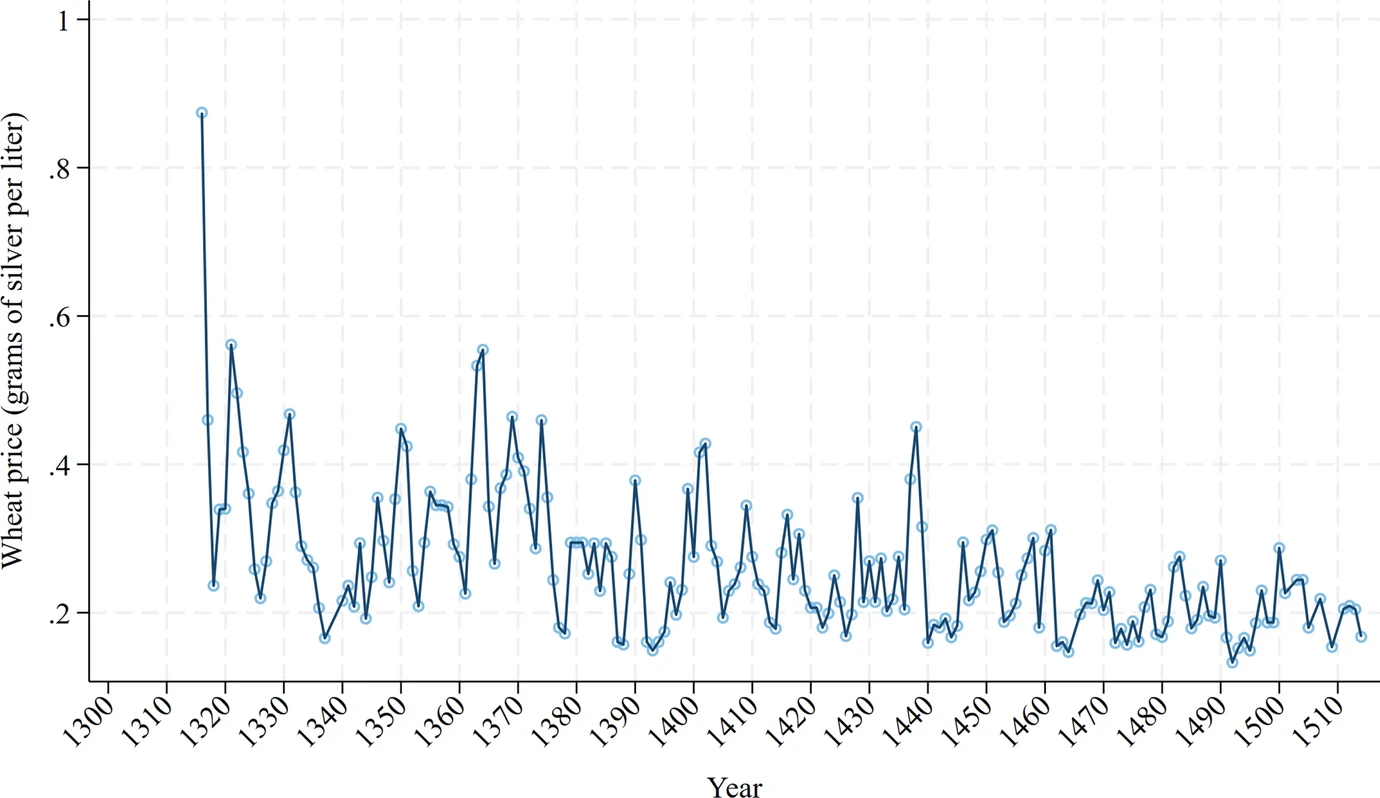
Wheat price in Exeter: 1316–1514