Author: Matthew Curtis, David de la Croix, Filippo Manfredini, Mara Vitale
Abstract:
We present new annual time-series data on academic human capital across Europe from 1200 to 1793, constructed by aggregating individual-level measures at three geographic scales: cities, present-day countries (as of 2025), and historically informed macro-regions. Individual human capital is derived from a composite index of publication outcomes, based on data from the Repertorium Eruditorum Totius Europae (RETE) database. The macro-regional classifications are designed to reflect historically coherent entities, offering a more relevant perspective than modern national boundaries. This framework allows us to document key patterns, including the Little Divergence in academic human capital between Northern and Southern Europe, the effect of the Black Death and the Thirty Years’ War on academic human capital, the respective contributions of academies and universities, regional inequality across Catholic and Protestant areas of the Holy Roman Empire, and the distinctiveness of the Scottish Enlightenment.
Keywords: Human capital, Universities, Academies, Preindustrial Europe, Long-run growth, Little divergence
Published on Explorations in Economic History, Volume 101, 2026,
https://doi.org/10.1016/j.eeh.2026.101756.
Open access and free to download
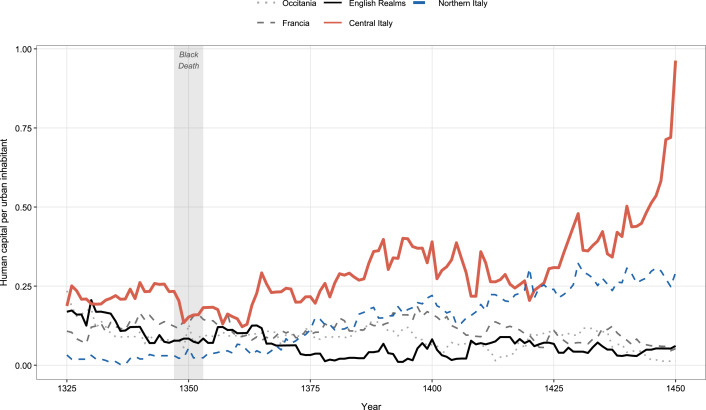
Fig. 4. The effect of the Black Death in the macro-regions following the Parisian model (the English Realms, Francia, and Occitania) and the macro-regions following the Bolognese model (Northern Italy and Central Italy).