Author: Aaron Graham
Studies of state formation and state-building in early modern Britain have almost overwhelmingly focused on how domestic resources were mobilised, taking for granted that the state existed practically in a state of autarky that mirrored the ‘glorious isolation’ of the nineteenth century. Examining the role that foreign manpower and money played between 1688 and 1815 in this paradigmatic ‘fiscal-military state’ suggests that British state formation can instead be understood in this period as a partnership between the state and what has recently been conceptualised as a European ‘fiscal-military system’, a series of cosmopolitan networks and hubs that moved military resources around Europe. The British state was structurally dependent upon the foreign manpower and money it supplied in order to maintain its paradoxical combination of powerful wartime mobilisation, low peacetime taxation and the preservation of British political liberties. Easy access to these resources enabled ministers to retain a bare-bones military and naval establishments in peacetime and then, in wartime, to ‘surge’ the state by using off-the-shelf foreign military labour to hold the line while British forces were recruited. Relying upon cheap foreign money enabled the British state to hold down taxation and expensive borrowing. After 1780, however, British ministers began to lose access to the European fiscal-military system and were forced to look to domestic resources, which generated damaging political conflicts within Britain. The transition to a fiscal-military state in ‘glorious autarky’ therefore occurred long after the existing historiography supposes, and largely out of necessity rather than by choice.
Published on The English Historical Review, Volume 141, Issue 608, February 2026, Pages 110–135, https://doi.org/10.1093/ehr/ceaf198
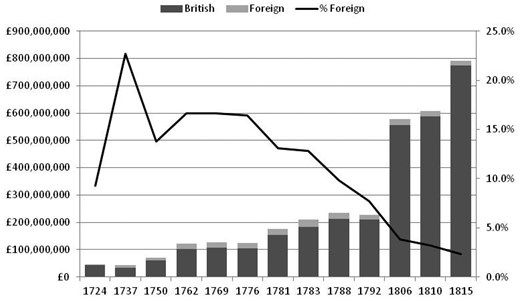
Figure 4:Foreign investment in British public debt, 1724–1815
Sources: Dickson, Financial Revolution, pp. 312, 321–2; Carter, Getting, Spending and Investing, pp. 32, 37; Wright, ‘Contribution of Overseas Savings’, p. 65.