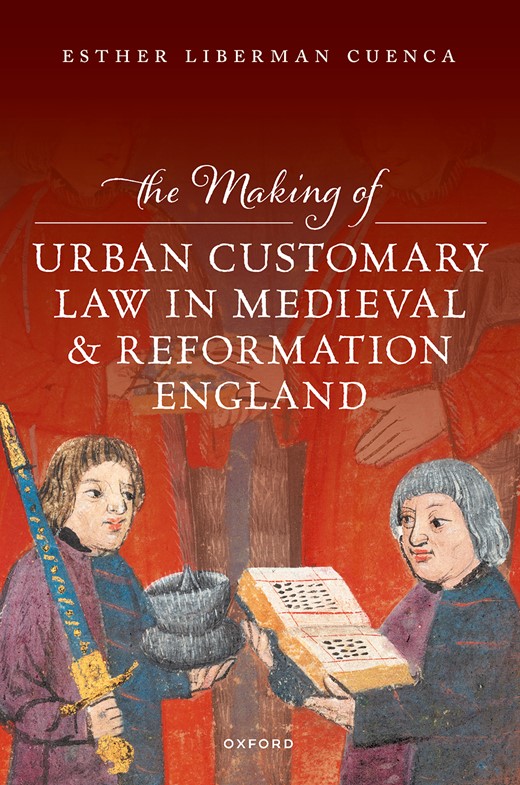
Author: Esther Liberman Cuenca
Published: June 2025, Oxford University Press
ISBN: 978-0198916772
Abstract:
This book examines the development of urban customary law from the twelfth to the sixteenth centuries and argues that urban customs were crucial to the development of a distinct, bourgeois identity in medieval and Reformation England. Urban customary law regulated political officeholding, trade, property holding, and even moral behavior in English towns. This book explores the forms, genres, and content of urban customary law, which could appear in standalone and compilation custumals, as well as charters granted to towns by royal, seignorial, or ecclesiastical lords. This book makes two principal claims: First, customary law advanced the business interests of an urban oligarchy. These were urban (male) elites who drafted laws and obtained privileges to enhance their wealth and assert their political independence from local lords. They often made claims about the legitimacy of their privileges or laws by rooting them in history or some kind of ancestral past. These lawmakers also made considerable efforts to establish their identities as morally upright and even-handed patriarchs. Second, urban customary law lent particular meanings to the “common good” in towns, as it helped lawmakers articulate policies that cohered with their vision of an ideal civic community.