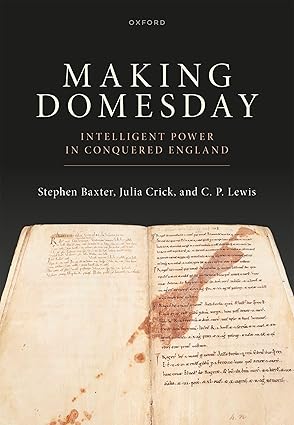
Authors: Stephen Baxter, Julia Crick, C. P. Lewis
Published: Oxford University Press, August 2025
Abstract:
Making Domesday presents a fresh interpretation of William the Conqueror’s survey of England, made possible by a major collaborative study of Exon Domesday, the earliest and least known of the three original manuscripts surviving from the Domesday survey. The book addresses big questions about pre-modern government, written records, and the use of intelligence in both senses: rational thought and information. Using Exon, it reconstructs the work of a writing office that over ten weeks in summer 1086 dealt with one of the seven ‘circuits’ (regional groupings of shires) of the Domesday survey. The circuit offices recast the manorial descriptions assembled earlier into an interim form for further redaction as Great Domesday Book. A new deep understanding of the codicology and palaeography of Exon offers a model of documentary production for royal government at an exceptionally early period. Part I analyses each Exon text in detail; Part II places Domesday as a whole in context through comparative perspectives. The two parts together provide a new understanding of both the Domesday survey and Domesday Book. The survey involved the production of different kinds of text intended to meet a range of fiscal and political needs, and was immediately effective, transforming the politics of land in a newly conquered society. The book’s central contention is that Domesday was a feat of intelligent government deployed by an aggressive and ambitious regime. As such it speaks to broader concerns with the colonial domination of conquered societies through the purposeful collection of systematic statistical information.